Revelation 2:12-17
12 “And to the angel of the church in Pergamum write: ‘The words of him who has the sharp two-edged sword.
13 I know where you dwell, where Satan's throne is. Yet you hold fast my name, and you did not deny my faith even in the days of Antipas my faithful witness, who was killed among you, where Satan dwells.
14 But I have a few things against you: you have some there who hold the teaching of Balaam, who taught Balak to put a stumbling block before the sons of Israel, so that they might eat food sacrificed to idols and practice sexual immorality.
15 So also you have some who hold the teaching of the Nicolaitans.
16 Therefore repent. If not, I will come to you soon and war against them with the sword of my mouth.
17 He who has an ear, let him hear what the Spirit says to the churches. To the one who conquers I will give some of the hidden manna, and I will give him a white stone, with a new name written on the stone that no one knows except the one who receives it.”
Archaeological evidence indicates that Pergamum was settled as early as the 8th century (800 years) BC. Little is known about Pergamum until the Hellenistic period, when Pergamum and all of Asia Minor came under the control of Alexander the Great. After the death of Alexander in 323 B.C.E., Lysimachus, one of Alexander’s generals (the Diadochoi) involved in the struggle for Alexander’s kingdom, eventually gained control of all of Asia Minor. He deposited a considerable sum of wealth in the treasury of Pergamum and appointed one of his officers, Philetaerus, as its overseer.1
 Pergamum became a major center of learning in the ancient world. The Greeks built monumental temples, theatres, stoa (porticoes), gymnasiums, altars, and libraries, set into the sloping terrain, surrounded by an extensive city wall. The Attalid dynasty (named after the man who ran the region after the death of Alexander the Great) founded one of the largest libraries in Pergamon, and the rivalry between three Hellenistic dynasties caused the Attalid Dynasty to create a famous sculpture school in the city.2
An important god to Pergamum was Asclepius (pronounced es-cleep-ius), the god of medicine and healing. During the Greek Era, the Asclepion (pronounced es-cleep-ion) was built. It was the first medical center (hospital) of the ancient world. The Asclepion, considered a holy place and the first medical center (hospital) of the ancient world, has existed since the 4th century B.C. and was developed during the Hellenistic period, but lived its brightest time in the 2nd century A.D. during the Roman era.3 Many Asclepions were built by the Greeks. They became the training centers for physicians around the Greek empire. Roman citizens from all over the empire went to Pergamum when they became ill. Pergamum became the center, or hub, in the medical world, attracting both patients and physicians. Pergamum was the center of the healing cult. The worship of Asclepius coexisted with other beliefs; over the course of centuries, the god easily syncretized with other deities, sometimes even superseding them.4
The ancient city of Pergamum had an altar to Zeus that was 118 x 108 feet. It had a 66-foot-high staircase leading up to the altar.5 The altar would have been the hub of religious activity in the city. Pergamum also has a temple dedicated to Athena, who was the goddess of wisdom, warfare, and strategy. In Greek mythology, Athena was the daughter of Zeus, so it makes sense that the people of Pergamum worshiped both Zeus and Athena. However, Pergamum also had temples dedicated to Hera (Greek goddess of marriage, women, childbirth, and the sky, and the queen of the gods and wife of Zeus) and Demeter (Greek goddess of the harvest, grain, and fertility). Due to the volcanic soil around Pergamum, the area was rich farmland. Demeter worship, therefore, would have been a natural choice.
During the Roman era, the proconsul, the regional ruler of Asia, was stationed in Pergamum. The proconsul of Asia possessed unlimited imperium, which included “ius gladii,” or “the right of the sword.” When an emperor permitted a governor to wear a sword, the Roman proconsul could execute anyone who disobeyed his orders (see Tacitus, Histories, 3.68; Dio Cassius, Roman History, 53.13.6-7 & 53.14.5). This deadly and powerful “right of the sword” commanded the obedience of Pergamene citizens. Capital punishment cases did not have to be referred to Rome. The proconsul in Pergamum decided who lived and who died.6
Reverlation 2:12
12aTo the angel of the church in Pergamum. Following the pattern of the other letters, this one was also to the angel of the church. What, or rather, who, are these angels? Theologians have struggled to define their identity for two thousand years. The Greek word “ἀγγέλῳ - aggelos” (Strong's G32, GK# 34), can be translated as angel or messenger. There are several thoughts on who they are:
8a To the angel of the church in Smyrna. Following the pattern of the other letters, this one was also to the angel of the church. What, or rather, who, are these angels? Theologians have struggled for two thousand years, trying to determine who exactly they are. The Greek word “ἀγγέλος - aggelos” (Strong’s G32, GK# 34) is typically translated as an angel or a messenger. There are several thoughts on who they are:
1. actual angels.
2. a human representative of them, i.e., the bishop of the church.
3. they are a personification of the church.
In the first theory, if the angel is an actual angel, then we can infer that each church has its own “guardian” angel. There is a major problem associated with ἀγγέλος being an “angelic” angel. The problem lies in that it seems improbable that Christ would use a human to write a physical letter to an angel, rebuking it for falling short in its duties as a Christ-follower.7 If the angel is an actual angelic representative of the local church, and answerable for its failure, then the seven angels in chapters 1 through 3 failed miserably. Is that type of failure even possible for an angel? I don’t think so.
The second theory is that the Greek word aggelos is a human messenger instead of an angel. This theory deems the letter addressed to a human messenger rather than an angelic one. The main problem is that aggelos is always translated as an angel in Revelation and used in that context.8 This interpretation does not mean that aggelos cannot refer to a human being as a messenger; it is simply not typical in the book of Revelation. The problem with assigning the pastor or bishop as messengers are that they are not referred to as messengers (or angels) anywhere in the New Testament. If it were a common practice to refer to the chief person in the church as a messenger, this would be evident in the other letters in the New Testament, especially in Paul's. John did not use the appropriate word if he was addressing an elder, deacon, or pastor. The word aggelos could mean the person who delivered the letter. But that would require seven different messengers, one from each of the churches, to have traveled to Patmos to get the letter to deliver it. While this is not impossible, as John could have easily summoned a messenger from each church to receive the appropriate correspondence, it is not probable. Another problem with this theory is the letter is not written to a single person but to the entire church.
The third theory (I tend to side with this one) is that the “angel” is simply a personification of the church itself.9 A personification is an imaginary person or creature conceived to represent something. In this case, the angel represents the church. The angel of the churches was not simply touched by the faults of the church but were guilty of them as well.10 John wrote to an “angel” about the sins of the church. Since judgment is coming for those sins, it is not logical that the angel would be a heavenly being. The letter starts as if being written to an angel, but there is no doubt that the congregation is the focus of the letter. It is my opinion, therefore, that the “angel” is a symbol, or personification, of the church rather than one of the heavenly angelic hosts.
12b … write: ‘The words of him who has the sharp two-edged sword. Where our English verb "to have" primarily emphasizes possession and control of external things, the Greek verb “has” mainly describes the set of features that collectively define identity. When someone "has" something (say: a sword), that something helps to determine who that person is, what his past might have looked like, and what his future might be all about.11 The church at Pergamum would have had the image in their mind of the Roman battle sword.
The standard sword used by the Roman soldier was called a gladius
(Latin for “sword”). The gladius was a short, one–handed sword, measuring 24–30 inches (60–70 cm) with a double-edged blade and a very sharp tip, and weighing only about 3.5 pounds. This short sword allowed a soldier to step inside the enemy's guard and thrust it in any direction at a deadly speed. The wooden hilt, where the soldier's hand holds onto the sword, featured a rounded grip, with four finger ridges carved in to allow a comfortable and firm hold upon the sword.12 The gladius was a stabbing sword for close in, or hand–to–hand combat. The sharp, tapered tip could also penetrate enemy armor, making it a very deadly close–in weapon.
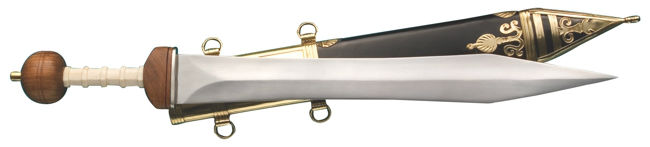
It was in the crush of battle that, when the Roman army pressed up against the enemy and pushed its way through, the gladius proved its worth. The gladius was the ideal weapon for stabbing the enemy in close quarters. Longer weapons were useless in close-quarters combat due to the lack of room required by long-slashing swords and thrusting spears. The Roman soldiers trained to deploy their swords horizontally, which allowed the blade to pierce the enemy's ribs and penetrate vital organs easily.13 Holding the sword horizontally also allowed it to be swung back and forth with devastating results.
At the time John wrote the letter, Pergamum would have had a Roman official (called a Proconsul) in charge of the city and the surrounding area. That official had the authority to use the garrisoned soldiers to execute enemies of the state. The symbolism of the sword in this verse is to demonstrate Jesus’ ability and right to assess who stands against him and execute judgment against that person.
Jesus has such a sword. Hebrews 4:12 (ESV) states, For the word of God is living and powerful, and sharper than any two-edged sword, piercing even to the division of soul and spirit, and of joints and marrow, and is a discerner of the thoughts and intents of the heart.
Not only does Jesus hold the sword, but he is the sword. According to John 1:1, In the beginning was the Word, and the Word was with God, and the Word was God.
So it is interesting that verse 12 has the phrase, the words of him who has the sharp two-edged sword.
This phrase refers to the words of Jesus, words of truth, that condemn those who deny the truth. Jesus’ words of authority are his weapon. There is a war for truth going on in Revelation, and it’s often fought with words, which isn’t surprising, given the Word leads this battle.14
Let’s paraphrase verse 12 back together again piecing together what we have learned. To the messenger of the church in Pergamum, write: 'The one who holds the sharp, two-edged sword, says this:
Reverlation 2:13
13aI know where you dwell, where Satan's throne is. What is Satan’s throne? Many theolgians think that the enormous altar to Zeus may be what Jesus was referring to. Zeus was the king of the gods, and the god of the sky, weather, law and order, destiny and fate, and kingship. In Greek mythology, Zeus created the world, humanity, plants, animals, and birds. He was depicted as a regal, mature man with a sturdy figure and dark beard. His usual attributes were a lightning bolt, a royal scepter, and an eagle.15 Sacrifices to Zeus would have been offered almost continuously, seven days a week. The problem we encounter is that there is a major difference between an altar and a throne. An Altar represents prayer, while a throne represents civic government.16 Therefore, I think that most theologians are asking the wrong question. The wrong question is what was Satan’s throne? The correct question is “Why did Satan choose Pergamum to set up his “throne?”
 The key to understanding this church is its physical geography, in connection with demonic geography (so to speak). This ecclesiastical and Satanic geography is significant, for the devil’s dwelling in the same city wherein this church dwelt affected the congregation spiritually.17 The image on the left is a map of the Roman Empire. The black circle represents how far Christianity had spread at the time the letter to Pergamum was written. Pergamum is in the center of the circle of the map. It just happens to be in the epicenter of the Christian world at that time. Can it be a coincidence that Satan set up his “throne” in the exact center of the Christian world? Satan’s “throne” represents his “spiritual” government, or his rule and reign over his demonic kingdom. It would not have been a physical throne, but he had, for some reason, set his headquarters in Pergamum.
13b Yet you hold fast my name, and you did not deny my faith. In this portion of the verse, Jesus commended the church for holding fast to his name. What does that mean? The term hold fast (Greek word krateó – Strong’s G2902) means to lay hold of, grab onto, seize.
18 Thus, we are to explore it, explain it, embrace it, protect it, offer it to others by making it known, and focus upon it with dedication and devotion.19 The word name (Strong’s G3686) means more than just a name. It includes the reputation, authority, and character that go with the name.20 To hold fast to Jesus’ name is to be loyal to him, especially in difficult times. Toward the end of the first century, Emperor Domitian issued a decree requiring all in his empire to worship him as "God the Lord." Residents of the empire were ordered to come to the public square, burn a pinch of incense, and speak the words Caesar kurios, “Caesar is lord.” This act of devotion seemed little enough in light of the emperor’s divine power and benevolence toward his subjects. Refusal could result in imprisonment, property confiscation, banishment, and even death. Christians, however, did refuse. They confessed a higher allegiance: Iesous kurios, “Jesus is Lord,”21
13c even in the days of Antipas my faithful witness, who was killed among you, where Satan dwells. Nothing is known about Antipas other than that Jesus held him up as an example for others to follow. According to tradition,
Antipas was the bishop of the church in Pergamum and a disciple of the Apostle John.22 None of the early church fathers wrote about him, so we only know what we are told in this verse. All anyone can do is speculate. It is interesting, however, that the verse specifically points out that Antipas was killed in the city where Satan dwells. Apparently, Satan did not like having Christians in “his” city and declared war on them.
Let’s paraphrase verse 13 back together again piecing together what we have learned. I know where you live. Satan's throne is there. Yet you hold on to my name and have not denied your faith in me, even in the days of Antipas, my faithful witness, who was killed in your presence, where Satan lives.
Revelation 2:14
But I have a few things against you: you have some there who hold the teaching of Balaam, who taught Balak to put a stumbling block before the sons of Israel, so that they might eat food sacrificed to idols and practice sexual immorality.
Anytime Jesus says that he has a few things against you, that should command your immediate attention. Understanding this verse requires an understanding of an incident that occurred in the Old Testament during the years Moses was leading Israel. According to Numbers 31:14-16, Balaam (a false prophet) told Balak (King of the Moabites) that Moab might defeat Israel if he had the Moabite women act as prostitutes amongst the Israelite men and invite them to worship their gods, offer sacrifices, and eat the food offered to their idols. The Israelite men fell for this trap, which greatly angered God. God sent a plague that killed twenty-four thousand (apparently the number who sinned against God). The idolatry, eating food sacrificed to the idols, and sexual immorality took a heavy toll on the Israelites. Jesus was now informing the church that sins are still not tolerated by God.
What is a stumbling block?
The Greek word translated as stumbling block
is skandalon (Strong’s G4625), which does not occur in Greek writing other than the New Testament, which demonstrates that it wasn't common to Greek but recently imported, probably from a Sanskrit derivative.23 The lack of extrabiblical examples makes skandalon a difficult word to translate accurately. It is translated several ways, such as offense, stumbling block, trap, and snare. A skandalon is some kind of trap, but scholars are unsure exactly what type of trap it was. The editorial staff at Abarim Publications thinks it may have been a fish trap that allowed fish to swim in but not out.24
Physically, a stumbling block is anything that causes a person to stumble and fall down. Spiritually, a stumbling block is anything (anyone) that causes a person to fall into sin. It is therefore logical to conclude that skandalon refers to a spiritual stumbling block.
Some of the Christians at Pergamum (we don’t know how many) were eating meat of the animals sacrificed to pagan gods, which had been available in the market. The problem was that the Jerusalem Council had settled that matter several decades earlier by urging Gentile converts to abstain from meat sacrificed to idols (Acts 15:29). This decision was made not to promote legalism but to maintain peace within the church. Since eating meat offered to idols was a divisive issue—carrying the possibility of scandalizing fellow believers—abstinence was expedient.25 This decision prevented believers from being accused of participating in idol worship, even though they were not present when the sacrifice was made (guilty by association). It also prevented Gentile converts from offending Jewish converts. Additionally, the Old Testament law (Exodus 34:15) forbade eating food offered to idols.
Revelation 2:15
So also you have some who hold the teaching of the Nicolaitans.
This verse begs the question: What are the teachings of the Nicolaitans? Very little is known about the Nicolaitans outside of the two references to them in the Bible. Revelation 2 13-15 seems to draw a parallel between Balaam’s seduction and that of the Nicolaitans. The Nicolaitans seem to be trying to do to the church what Balaam tried to do to Israel. The treachery concerned two things 1) eating foods sacrificed to idols and 2) engaging in sexually immoral acts (Num 22-24).26 The Nicolaitans committed fornication, adultery, and all uncleanness. They had their wives in common and ate things offered to idols.27 The latter probably refers to eating food sacrificed to idols in the context of idolatrous worship. The Nicolaitans were probably advocating participation in the worship service of the local church and the local pagan temple (a similar problem existed at Corinth; see 1 Corinthians 10:14-22).28 Dr. Eli Lizorkin-Eyzenberg wrote the following:
In Hebrew in order to say “we will eat” verb נאכל (nokhal) would have been used. We read in Is.4:1, “And seven women shall take hold of one man in that day, saying, “We will eat (נֹאכֵ֔ל) our own bread and wear our own clothes, only let us be called by your name; take away our reproach. If this Hebrew word נאכל (nokhal) is transferred into Greek it can be used as a term describing the “we will eat” people. In a sense that this was their motto, their sentiment – “we will eat” the food that others think is forbidden (food offered to pagan deities). Thus τῶν Νικολαϊτῶν (ton nikolaton) “the Nicolaitans” as a group or teaching can originate from Hebrew נאכל (nokhal) “we will eat” making a cohesive connection to the context of Balaam and Balak and incident in the book of Numbers referred to in Rev. 2:13-15.29
The two issues of 1) eating foods sacrificed to idols and 2) engaging in sexually immoral acts were serious enough for Jesus to chastise the church about directly. The church at Pergamum was beginning to look just like the world around them. It destroys the message of the gospel when sinners cannot see any difference between themselves and a Christian.
Revelation 2:16
Therefore repent. If not, I will come to you soon and war against them with the sword of my mouth.
Jesus offered those in the church who had compromised their faith a chance to repent. Notice the distinction between I will come to you (the church) soon and war against them (the false teachers and their followers). Jesus was only going to war against the false teachers and those who held to their false teaching. He was not going to war against the Christians who refused to follow the false teachers. We do not know how long that door for repentance would remain open, but we do know that the door would shut at some point in time. This was a repent or else command. Unless they do repent, the compromised Christians of Pergamos would face the Jesus who has the two-edged sword. Judgment will begin at the house of God (1 Peter 4:17).30
The call to repentance was centered around the false teaching of moral compromise. The phrase “if not, I will come to you soon” indicates the imminent nature of Christ's intervention if the compromised failed to repent. The word soon indicates that they do not have much time to repent. The call for repentance is not only for those who have fallen astray, but for those who are leading the church astray.
What should have disturbed the church the most was that Jesus would war against them if they refused to repent. That was a very serious threat, not to be taken lightly. The members of the church who had compromised their faith would have immediately correlated Jesus’ threat with the Roman Proconsul’s ability to decide who lived and who died. What does it mean that Jesus would war against the false teachers and their disciples? Jesus was warning them that He determines who lives and who dies. For the compromised Christians, to repent was to live; to continue walking in compromised faith was to die. The threat and punishment would have been very clear to the church at Pergamum.
Revelation 2:17
He who has an ear, let him hear what the Spirit says to the churches. To the one who conquers I will give some of the hidden manna, and I will give him a white stone, with a new name written on the stone that no one knows except the one who receives it.’
The phrase he who has an ear
qualifies everyone who will listen and obey. It is a phrase Jesus often used when speaking in parables. Whenever Christ says, "He who has an ear, let him hear," He calls for people to pay careful heed. It's another way of saying, “Listen up! Pay close attention! What I said was important!” Those who have “ears to hear” allow the Word to bear fruit to the glory of God. It is up to the hearer to decide whether to take the Word seriously and try to understand and obey it. The church is called to pay close attention and seek God’s wisdom regarding the written Word. Only a few are willing; the rest have ears but do not have “ears to hear” (Matthew 7:13–14, 24–27).
The phrase to the one who conquers I will give some of the hidden manna begs the question: Conquer what?
First off, the word conquers can also be translated as “to conquer, overcome, or be more than victorious.”31 The church needed to overcome the compromised Christianity they were living in and get back to really living
for Christ. In the context of Pergamum, conquering (overcoming) is equated with refraining from eating meat sacrificed to idols and from immoral activities. For those who had already compromised their faith, it meant repenting and refocusing on Christ.
What is the hidden manna? In the Old Testament, manna was how God sustained and provided food for the Israelites as they traveled in the wilderness. Manna was literally the bread of life
that came down and kept the Israelites alive. God also instructed Moses to put a pot of manna in the Ark of the Covenant (Exodus 16:33-35). Instead of eating meat sacrifices to idols, Jesus offered them something better, hidden manna. The hidden manna would not be physical food but spiritual food that would adequately prepare and equip them to rule and reign in the kingdom of Heaven.
The phrase and I will give him a white stone has caused much confusion. White stones had several usages in ancient Greece, but one fits the context of this letter. According to Ovid, Metamorphoses 15, verse 41, It was an ancient custom of that land to vote with chosen pebbles, white and black. The white absolved, the black condemned the man.
32 In a judicial context, the jury made their decision by placing either a white stone (innocent) or a black stone (guilty) into a clay jar. The judge would then count the stones and declare the person on trial to be either innocent or guilty, depending on the number of white or black stones. In this context, Jesus will provide the overcomer with a vote of absolution. Jesus will declare them to be not guilty.
The phrase with a new name written on the stone may signify a new beginning. Throughout the Bible, God would change a person’s name at a significant point in their life as they spiritually changed. For example, Abram was renamed Abraham, Jacob was renamed Israel, Hoshea was renamed Joshua, Simon was renamed Peter, and Saul was renamed Paul. Their new names marked a new beginning. Giving these believers a new name that only they knew demonstrates God acting in their lives on a very personal level.
Application
Jesus's letter to Pergamum challenges us to remain faithful to the Lord despite the peer pressure, to avoid compromise, and maintain sexual purity. While eating meat sacrificed to idols may not be an issue for the church today, there are many other ways that we can compromise our faith. Trying not to get canceled
in todays world which is increasingly hostile to God’s truth and Christianity, can cause many Christians to make compromises. God calls Christians to be bold as a lion. Fear of being labeled as hateful, bigoted, not inclusive, or even self-righteous
has caused many believers to remain silent. Remaining sexually pure is discouraged in today’s society. Christians are bombarded by the media and friends to be sexually active, which goes directly against the Bible. Too many Christians are sexually active when God calls them to be sexually pure. The warning to the church at Pergamum should also be a warning to the church today. God does not tolerate compromise or sexual impurity. The call to repent is still open to us, for now.
Would you like information on how to become a Christian?
Touch the button below for Steps to Salvation
✝ Salvation
Have a question or comment about “Pergamum?”
Touch the button below to send Steven P. Wickstrom an e-mail:
E-mail
To print “Pergamum” click the button below to download the PDF file.
Print
Footnotes
[1] Clyde E. Fant and Mitchell Glenn Reddish, A Guide to Biblical Sites in Greece and Turkey (New York, NY: Oxford University Press, 2020). ↩
[2] Editorial Staff, “Pergamon and Its Multi-Layered Cultural Landscape.,” UNESCO World Heritage Convention, accessed October 30, 2025, https://whc.unesco.org/en/list/1457/. ↩
[3] Tanju Varlikli, “Pergamon: City of Firsts,” Incirlik Air Base, accessed October 30, 2025, https://www.incirlik.af.mil/News/Commentaries/Display/Article/2848530/pergamon-city-of-firsts/. ↩
[4] Rachel Herschman, “A Temple of Healing – the Empire’s Physician,” The Empires Physician, 2021, accessed November 4, 2025, https://exploregalen.com/project/a-temple-of-healing. ↩
[5] On the Pergamon altar, see Wolf-Dieter Heilmeyer (ed.), Der Pergamonaltar. Die neue Präsentation nach Restaurierung des Telephosfrieses. Wasmuth, Tübingen 1997, ISBN 3-8030-1045-4; Huberta Heres & Volker Kästner: Der Pergamonaltar. Zabern, Mainz 2004 ISBN 3-8053-3307-2 ↩
[6] Paul T. Penley, “Why Jesus Shows off His Sword in Revelation 2,” web log, Reenactingtheway.Com, September 2, 2014, accessed November 20, 2025, https://www.reenactingtheway.com/blog/why-jesus-shows-off-his-sword-in-revelation-2. ↩
[7] Everett Ferguson, “Angels in the Churches of Revelation 1-3: Status Queastionis and Another Proposal,” Bulletin for Biblical Research 21, no. 3 (Jan 2011): 371-86. ↩
[8] Ibid. ↩
[9] Colin J. Hemer, The Letters to the Seven Churches of Asia in Their Local Setting, The Biblical Resource Series (Grand Rapids, Mich.: W.B. Eerdmans Pub., 2001), 33. ↩
[10] William Mitchell Ramsay, The Letters to the Seven Churches, updated ed., ed. Mark W. Wilson (Peabody, Mass.: Hendrickson Publishers, ©1994), 50. ↩
[11] “Εχω: Abarim Publications Theological Dictionary (New Testament Greek),” Abarim Publications, accessed November 3, 2025, https://www.abarim-publications.com/DictionaryG/e/e-ch-om.html. ↩
[12] Pat Southern, “The Roman Army: A Social and Institutional History.” Oxford: Oxford University Press, 2007. ↩
[13] Kelly, Patrick. “Iron of the Empire: The History and Development of the Roman Gladius.” www.myarmoty.com. https://myarmoury.com/feature_ironempire.html. ↩
[14] Chris Donato, “The Letter to the Church in Pergamum,” Ligonier Ministries, accessed November 3, 2025, https://learn.ligonier.org/articles/letter-church-pergamum. ↩
[15] Aaron J. Atsma, “Zeus - Greek God of the Sky, King of the Gods,” Theoi Greek Mythology, accessed November 4, 2025, https://www.theoi.com/Olympios/Zeus.html. ↩
[16] Joseph Mattera, “Seven Reasons Why Altars Are over Thrones,” Mattera Ministries International, accessed November 4, 2025, https://josephmattera.org/seven-altars-thrones/. ↩
[17] Angus Stewart, “Pergamos: A Church Dwelling Where Satan’s Throne Is,” PRCA, May 2014, accessed November 4, 2025, https://www.prca.org/resources/articles/pergamos-a-church-dwelling-where-satans-throne-is. ↩
[18] Spiros Zohiates, The Complete Word Study Dictionary: New Testament (Iowa Falls, IA: World Bible Publishers, Inc., 1994), 885. ↩
[19] Sam Storms, “Holding Fast to the Word of Life (3),” Sam Storms: Oklahoma City, Oklahoma, accessed November 4, 2025, https://www.samstorms.org/enjoying-god-blog/post/holding-fast-to-the-word-of-life--3-. ↩
[20] Moisés Silva, New International Dictionary of New Testament Theology and Exegesis, 2nd ed., vol. 3, 5 vols. (Grand Rapids, MI: Zondervan, Credo Reference, 2019), 520. ↩
[21] Rex Butler, “Geaux Therefore,” “Swear by the Genius of Our Lord the Emperor”: False Worship and Persecution of Christians, October 17, 2016, accessed November 4, 2025, https://www.nobts.edu/geauxtherefore/articles/2016/swear-by-the-genius-of-our-lord-the-emperor--false-worship-and-persecution-of-christians.html. ↩
[22] “Hieromartyr Antipas, Bishop of Pergamum and Disciple of Saint John the Theologian,” Orthodox Church in America, accessed November 4, 2025, https://www.oca.org/saints/lives/2018/04/11/101052-hieromartyr-antipas-bishop-of-pergamum-and-disciple-of-saint-joh. ↩
[23] Moisés Silva, New International Dictionary of New Testament Theology and Exegesis, 2nd ed., vol. 4, 5 vols. (Grand Rapids, MI: Zondervan, Credo Reference, 2019), 296. ↩
[24] Abarim Publications, “Σκανδαλον: Abarim Publications Theological Dictionary (New Testament Greek),” Abarim Publications, January 8, 2021, accessed November 12, 2025, https://www.abarim-publications.com/DictionaryG/s/s-k-a-n-d-a-l-o-n.html. ↩
[25] "What does the Bible say about eating food/meat that has been sacrificed to idols?" Got Questions Ministries, accessed February 15, 2017, https://www.gotquestions.org/food-sacrificed-idols.html ↩
[26] Eli Lizorkin-Eyzenberg, “Who in the World Were Nicolaitans?,” Israel Institute of Biblical Studies, accessed November 13, 2025, https://israelbiblicalstudies.com/blog/category/jewish-studies/nicolaitans/. ↩
[27] John Gill, John Gill’s Exposition of the Entire Bible (www.e-Sword.net). ↩
[28] Sam Storms, “10 Things You Should Know about the Nicolaitans,” Samstorms.org, accessed December 8, 2022, https://www.samstorms.org/all-articles/post/article-10-things-you-should-know-about-the-nicolaitans. ↩
[29] Eli Lizorkin-Eyzenberg, “Who in the World Were Nicolaitans?,” Israel Institute of Biblical Studies, accessed November 13, 2025, https://israelbiblicalstudies.com/blog/category/jewish-studies/nicolaitans/. ↩
[30] David Guzik, “Enduring Word Bible Commentary Revelation Chapter 2,” Enduring Word, accessed November 13, 2025, https://enduringword.com/bible-commentary/revelation-2/. ↩
[31] Verlyn D. Verbrugge, New International Dictionary of New Testament Theology (Grand Rapids, MI: Zondervan, 2004), 387. ↩
[32] Aaron J. Atsma, “Ovid, Metamorphoses 15,” OVID, METAMORPHOSES 15 - Theoi Classical Texts Library, n.d., accessed November 21, 2025, https://www.theoi.com/Text/OvidMetamorphoses15.html. ↩
© 12 Dec 2025 by Steven P. Wickstrom, all rights reserved. Click the button below for more information about the copyright.